Introduction
Starting your own toothpaste brand might seem like a niche or “small” consumer business, but the truth is, it involves many of the same financial and operational challenges as launching any CPG (consumer packaged goods) company. To create a successful toothpaste line, you need money not just for making the product, but for research, testing, compliance, branding, logistics, and more.
In this article, I’ll walk you through a realistic budget framework — drawing from industry-typical costs, private-label manufacturing benchmarks, and insights from emerging brands — to estimate how much capital you need in U.S. dollars to start your own toothpaste business.
Market Landscape: Why Now Might Be a Good Time
Before diving into the numbers, it helps to understand the market context.
Oral care is a mature but still-evolving segment. Emerging “indie” and premium toothpaste brands — especially those offering functional or “beauty-like” variants — are gaining traction. For example, the Chinese brand San-Ben used a cosmetic-style approach to create “net-red” toothpaste, positioning their product with premium ingredients and design.
On the cost front, raw materials are becoming more expensive. According to recent data, as consumers demand more refined, functional, and niche oral-care products, companies are investing more in higher-cost active ingredients.
For entrepreneurs, private-label manufacturing offers a way in: working with an existing manufacturer reduces the need for a full factory buildout, while still allowing branding and differentiation.
Given this, it’s entirely possible to launch a meaningful toothpaste brand — but what does it cost?
Major Cost Components for Launching a Toothpaste Brand
Here are the major categories you need to budget for, along with realistic cost estimates:
Product Development & Formulation
Manufacturing (Production)
Packaging & Labeling
Testing, Certification & Regulatory Compliance
Branding, Design & Marketing
Business Setup & Legal
Logistics, Inventory & Warehousing
Operating Cash Runway
I’ll break each one down below.
1. Product Development & Formulation
Formulating toothpaste involves more than just mixing base ingredients — you’ll likely want to define a formula (maybe customized), decide on actives (e.g., fluoride, herbal extracts, whitening agents), texture, flavor, shelf-stability, and regulatory compliance.
According to private-label cost structures, formulation can range from $500 to $5,000 depending on whether you use a stock formula or negotiate a custom one.
If you’re building a more unique formula (say, natural actives or more advanced ingredients), the higher end is more realistic.
Let’s assume a moderate custom formulation for a mid-scale/private label startup: $3,000.
2. Manufacturing
Assuming you’re not building your own factory but working with a private-label or toll manufacturer, this is where your per-unit costs matter.
Based on private-label sources, manufacturing costs typically fall in the $0.50 to $2.00 per tube range, depending on volume, ingredients, and packaging complexity.
Scale is critical: with small runs, your per-unit cost will lean toward the higher side.
Suppose you order 5,000 units as your first production run, and assume a mid-range cost of $1.20 per tube. That means $6,000 for manufacturing.
3. Packaging & Labeling
Packaging for toothpaste includes not just the tubes, but also boxes (if used), labels, and any printed materials. Design and unit costs both matter.
Private-label cost estimates suggest packaging costs of $0.30 to $1.00 per unit.
On top of per-unit packaging, you’ll likely pay for design work (packaging artwork, label, possibly a box).
Let’s estimate packaging design at $2,000 (graphic designer, iterations, mockups) + $0.60 per unit × 5,000 = $3,000 for packaging materials, so $5,000 total.
4. Testing, Certification & Regulatory Compliance
Toothpaste is not a trivial product: you may need lab testing, safety testing, and certain certifications depending on your market.
According to private-label cost structures, lab testing/certification (e.g., GMP, FDA-style regulatory compliance) can run $1,000 to $3,000.
If you’re planning to market “natural,” “organic,” or “fluoride-free,” or aim for certain certifications (e.g., vegan, cruelty-free), additional testing or audits may be required.
Budget a mid-point here: $2,000.
5. Branding, Design & Marketing
Building a brand means more than naming: you need visual identity, website, digital channels, initial marketing (ads, samples), and perhaps influencers.
According to private-label cost estimates, branding and marketing could be $1,000 to $5,000+, depending on scale.
But a well-thought-out launch can require more, especially if you do content marketing, social media, influencer collaborations, or paid ads.
Let’s assume:
Logo & brand identity: $1,500
Website setup & e-commerce: $3,000
Initial marketing (ads, sampling, maybe influencer): $5,000
Total: $9,500.
6. Business Setup & Legal
You may need to register your company, trademark your brand, buy insurance, and potentially pay for legal counsel (especially with regulatory concerns).
Business registration: roughly $500–$2,000 typical for a small business.
Permits, certifications, regulatory/legal consultation: could be $1,000–$10,000, depending on complexity.
Insurance (liability, product liability): estimate $2,000–$8,000 per year for a physical product business.
For a lean startup, let’s budget:
Registration: $1,000
Legal / regulatory: $4,000
First-year insurance: $3,000
Total: $8,000.
7. Logistics, Inventory & Warehousing
After manufacturing, you need to ship, store, and manage inventory. These costs depend heavily on geography, volume, and whether you use third-party logistics (3PL).
Let’s assume your 5,000 units need to be stored in a small 3PL warehouse or rented storage space for a few months until you can sell them.
Estimate inbound freight, duties (if using overseas manufacturing), warehousing, and fulfillment buffer.
A rough ballpark: $2,000–$5,000 to store and handle your initial inventory, depending on where you’re located, how long storage is needed, and your shipping method.
Let’s budget $3,500.
8. Operating Cash Runway
To give your business a fair chance, you should have some cash runway to support operations: marketing, reorders, overhead, and possibly some buffer for unexpected costs.
A lean startup might aim to have 3–6 months of operating expenses in reserve.
Suppose your monthly “burn” (after launch) is modest — website hosting, sample shipping, marketing, replenishing inventory, customer service, etc. — maybe $2,000–$4,000/month initially.
Assume $3,000/month × 4 months = $12,000 runway.
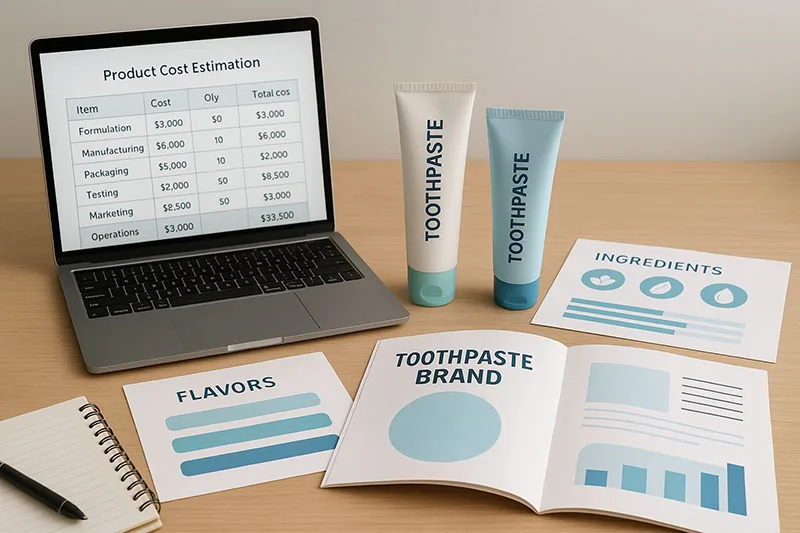
Summary Budget Table (Estimated)
| Expense Category | Estimated Cost (USD) |
|---|---|
| Product Development & Formulation | $3,000 |
| Manufacturing (5,000 units) | $6,000 |
| Packaging & Design | $5,000 |
| Testing & Compliance | $2,000 |
| Branding & Marketing | $9,500 |
| Business Setup & Legal | $8,000 |
| Logistics & Warehousing | $3,500 |
| Operating Cash Runway | $12,000 |
| Total Estimated Startup Budget | ~ $49,000 |
How to Adjust the Budget: Scenarios and Strategies
Scenario A: Lean Bootstrap Launch
If you have a very tight budget or want to validate the idea before scaling:
Use a stock formula (cheaper) — maybe pay $500–$1,000 instead of $3,000.
Start with a smaller production run (e.g., 1,000 units) — manufacturing costs go down, but per-unit cost may go up.
Keep branding expenses minimal — DIY your logo / packaging, use a simple Shopify or Wix site.
Rely on organic growth or low-cost marketing — social media, friends/family sampling, word of mouth.
Use shared warehouse space, or even fulfill from your home / garage initially.
With these trade-offs, you might be able to launch with $15,000–$25,000, though growth will be slower and risk is higher.
Scenario B: Mid-Scale, More Ambitious Launch
If you have more capital, want to build a serious brand from day one, and plan to scale:
Negotiate for a custom formula, higher-quality active ingredients (e.g., whitening agents, herbal extracts).
Order larger volumes (10,000+ units) to bring down per-unit manufacturing cost.
Invest in premium packaging (luxury tubes, boxes, premium labels).
Spend aggressively on digital marketing (influencers, paid ads, content).
Consider more formal certifications (e.g., cruelty-free, organic, or “clean” labels) to differentiate.
Use a 3PL or fulfillment partner that can scale.
Build out a customer service team and invest in retention.
In this case, your upfront budget could grow to $75,000–$150,000+, depending on scale and ambition.
Risks and Key Challenges to Budget For
When planning your budget, be realistic about potential risks and hidden costs:
Inventory risk: If you overorder, you might be stuck with units that don’t sell.
Quality issues: Poor batches, contamination, or formulation problems can lead to wasted inventory or recalls.
Regulatory risk: If compliance or testing isn’t handled well, you could run into trouble with authorities or face consumer backlash.
Marketing risk: Branding and customer acquisition costs might turn out higher than your initial estimate.
Cash runout: Without sufficient runway, your business may struggle before it finds traction.
Supply chain volatility: Raw material costs (e.g., active ingredients) can fluctuate; logistics costs may rise.
One tip from the founder community:
“Try and find a white label that is flexible to work with startups and can do smaller lot sizes. Even if it costs you more per unit, at this stage it’s still high risk … you keep sitting on inventory you can’t sell.”
This means it’s often better to start smaller, validate product-market fit, and then scale.
Real-World Examples & Precedents
San-Ben : This Chinese “indie” toothpaste brand gained rapid traction, in part by positioning its product more like a beauty/skincare item than a purely functional oral-care product.
According to B2Bprivate-label data, for many small to mid-scale toothpaste private-label brands, the total initial investment ranges between $10,000 and $25,000, if using stock formulations and modest runs.
However, if you go further and set up your own manufacturing facility: LaunchBiz.io estimates $50,000–$200,000+ just for setup and equipment.
These real-world benchmarks validate that your launch budget entirely depends on your model: Are you white-labeling / private-labeling, or building your own factory?
Tips for Reducing Costs Negotiate MOQs
Use a stock or semi-custom formula first: This reduces formulation cost and speeds up time to market.
Outsource design smartly: Use freelance designers or design contests for packaging to save on branding.
Leverage digital marketing: Start with low-cost channels like Instagram, TikTok, or micro-influencers.
Test market before scaling: Consider launching via direct-to-consumer (D2C) to validate demand before committing to large inventory.
Partner with a 3PL: Instead of building your own warehouse, working with a fulfillment partner can reduce capital tied up in storage.
Raise funds wisely: If the budget isn’t enough, consider a small seed round (friends & family, angel) once you have a prototype or sample.
Conclusion
So, how much budget do you need to start your own toothpaste brand? The honest answer is: it depends heavily on your business model, ambition, and risk tolerance.
With a lean private-label plan, you could start with as little as $15,000–$25,000, if you’re careful and focused.
A more serious, brand-first launch targeting quality, marketing, and scale could easily require $50,000–$100,000+.
If you’re building your own manufacturing capability from scratch, costs could run into hundreds of thousands of dollars, but this option also gives you more control and potentially higher margins long-term.
What’s most important is building a realistic business plan — one that accounts for formulation, production, compliance, branding, and the inevitable bumps along the way. Use the budget framework above to run scenarios (best-case, worst-case) and understand how much risk you’re willing to take.